
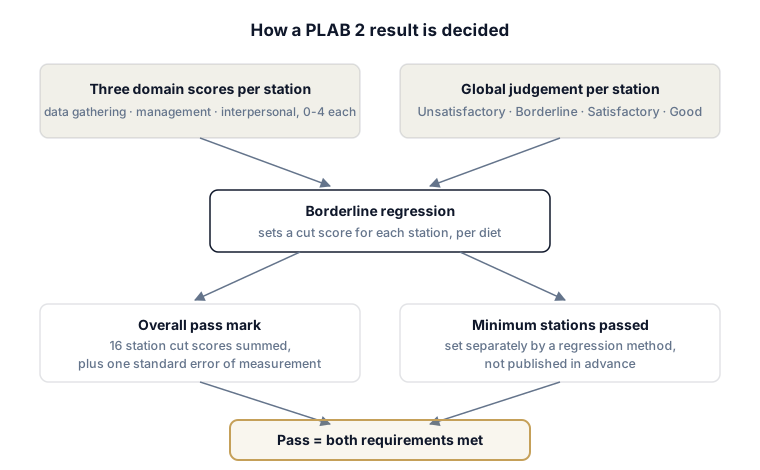
PLAB 2 has no fixed pass mark. For each diet, borderline regression sets cut scores across 16 scored scenarios, each assessed in three domains, and those station cuts feed into the overall standard.
You must clear both the aggregate mark and the station requirement calculated for that diet.
A steady set of competent consultations is safer than chasing every possible checklist item.
The three domains
The GMC assesses every PLAB 2 scenario against three domains. Each domain receives a score from 0 to 4, giving a maximum of 12 for one scored scenario. The domains carry equal numerical weight, but they test different parts of the same clinical performance.
Data gathering, technical and assessment skills
This 0 to 4 domain covers the information and findings needed to understand the problem: a focused history, appropriate examination or practical technique, sensible investigation choices and accurate interpretation.
In an eight-minute scenario, relevant information matters more than a long routine. A full systems review can still miss the urgent red flag, while a shorter history may identify the risk and support the next decision. Technical competence belongs here as well. In a procedure or examination station, the examiner looks for safe preparation, the correct sequence and meaningful findings. A memorised narration detached from the task will not do. In a consultation, useful questions are the ones that change the assessment. Checklist chasing can take 5 minutes and still leave the problem unclear.
Clinical management skills
The second 0 to 4 score covers what you do with the information gathered. A strong performance reaches a defensible clinical view, explains it accurately and proposes safe management at the level expected of a doctor entering Foundation Year 2. Depending on the scenario, that may include treatment, escalation, referral, follow-up, prevention or a specific safety net. The plan has to fit the person in front of you. Examiners can distinguish a generic list from a plan tied to symptoms, risk and preferences. Naming 6 possible treatments is less useful than choosing a safe first step, checking contraindications and saying what should happen if the condition worsens.
Interpersonal skills
Interpersonal skills receive the same 0 to 4 allocation, one third of the available 12 points. The domain covers listening, rapport, understandable language, professional behaviour, patient involvement, ethical awareness and responses to verbal or non-verbal cues. You can know the diagnosis and still lose substantial credit by firing closed questions, ignoring distress or announcing a plan without agreement. Empathy cannot rescue unsafe management either. The consultation must work as a whole: selective data gathering, a safe plan and communication that lets the patient understand and take part.
How borderline regression works
The examiner records 2 different things for each station. The three numerical domain scores add up to a total between 0 and 12. Separately, the examiner gives a standard-setting judgement of Unsatisfactory, Borderline, Satisfactory or Good. According to the GMC's results guidance, this global judgement does not by itself decide whether you passed the station. It helps set the cut score.
Borderline regression links the two. The statistical model compares candidates' numerical totals with the examiners' overall judgements and estimates the score associated with borderline performance. That estimate becomes the cut score for that station in that exam. One examiner is not choosing a permanent percentage before anyone has seen how the scenario performs.
The calculation can be followed in 4 stages:
- The examiner gives 3 domain scores and one global standard-setting judgement for each performance.
- The regression model estimates the numeric station score corresponding to borderline performance.
- The cut scores for all 16 scored scenarios are added together.
- One standard error of measurement, usually shortened to SEM, is added to that sum to create the minimum overall score.
Consider an illustrative example. These are invented numbers, not GMC figures.
Suppose the model produces station cut scores of 5.9, 6.4 and 7.0 for the first 3 scenarios, while the remaining 13 cut scores total 79.7. The 16 station cuts then sum to 99.0. If the hypothetical SEM addition were 2.0, the illustrative overall pass threshold would be 101.0.
The decimals matter even though candidates receive whole-number domain scores. The GMC explains that rounding individual station thresholds does not let a candidate reconstruct the aggregate requirement by adding the displayed station pass scores. The overall calculation uses the underlying cut scores, then adds one SEM. The examiner does not know the final station threshold while observing the performance because it is calculated after the exam.
This method exists because scenarios vary. An easier station should demand a higher numerical score for borderline competence, while a harder station may produce a lower cut. Borderline regression lets the standard respond to the scenario mix without declaring that a difficult diet has weaker doctors or that an easier diet deserves a fixed, arbitrary advantage.
A raw total from one diet cannot be compared directly with the same total from another because the station cuts and overall threshold may differ. There is no permanent pass percentage, nor a fixed number of stations that works for every exam. The GMC calculates a minimum-stations requirement alongside the overall score, and you have to satisfy both for your diet.
This can produce a result that looks strange at first. You may exceed the overall threshold but fail because you passed too few stations. You may also pass enough individual stations and remain below the overall mark. Several exceptional scores cannot safely cover repeated weak stations across the circuit.
What the November 2024 change was
In November 2024, PLAB 2 moved fully onto the borderline-regression CPSA scoring model described above. The verified mechanism has diet-specific station cuts, an overall threshold with an SEM addition, and a separate minimum-stations requirement. Claims about extra formula changes, new score bands or a permanent replacement pass percentage go beyond that account and should not guide preparation.
This is separate from the MLA alignment that began in August 2024. The guide to UKMLA and PLAB 2 explains the relationship. Borderline regression sets the result standard; MLA alignment sets the standard and content framework used by the assessment. The dates are close, but the changes concern different parts of the exam.
Older fixed-number advice is therefore unreliable. A post claiming that everyone needs the same percentage or station count cannot describe the current diet-level calculation. Your GMC result provides the applicable total, station cut scores and outcome for that exam.
Pass rates in context
The GMC's five-year table shows how candidate volume and pass rates have moved. These are annual population results, not fixed pass thresholds.
| Year | Candidates who sat PLAB 2 | Pass rate |
|---|---|---|
| 2021 | 8,648 | 69.9% |
| 2022 | 13,533 | 64.8% |
| 2023 | 15,702 | 62.9% |
| 2024 | 19,594 | 65.8% |
| 2025 | 14,689 | 59.8% |
Volume more than doubled between 2021 and 2024, rising from 8,648 to 19,594 sittings. It then fell by 4,905 in 2025, a reduction of about 25%. The later 2026 training prioritisation changes help explain why PLAB demand now sits inside a much harsher employment discussion, but a law enacted in March 2026 cannot be assigned as the cause of a fall recorded in 2025.
The pass rate fell by 6.0 percentage points between 2024 and 2025. That drop coincided with the broader MLA-era context discussed in the UKMLA comparison guide, but timing does not establish causation. The GMC table does not isolate changes in content, candidate mix, repeat attempts, preparation quality or station difficulty. It supports one firm conclusion: a 59.8% annual pass rate describes the 2025 cohort, not the score a future candidate must obtain.
The five-year pattern also shows why published pass rates cannot reveal whether a specific diet was easy. Borderline regression adjusts station cuts to difficulty, while the annual percentage records how many candidates cleared both result requirements after that adjustment. Standard setting and cohort performance are related, but they are not the same number.
Using the scoring model in practice
After every eight-minute attempt, record feedback for each GMC domain. A single pass or fail label conceals too much. Note missed or irrelevant data, unsafe or incomplete management decisions and interpersonal behaviour that changed the consultation. Look for recurrence across several stations before changing your study plan around one mistake.
For interpersonal feedback, check whether you noticed cues, explained risk without jargon, tested understanding and involved the patient before the eight minutes ended. These are observable behaviours, unlike a stock empathy phrase memorised in isolation.
Practise complete consultations. If you spend 8 minutes on history and rehearse management separately, you may never learn to protect time for explanation, safety-netting and closure. The six-week preparation plan uses timed spoken stations and domain review to build that discipline. After a failed result, the second-attempt guide can help separate a recurring domain weakness from one poor circuit.
A full 16-station mock can produce 48 domain observations before written comments are added. GK's PLAB 2 Study Centre's AI mock exam scores the same three domains across 16 stations. Use the report to look for recurring problems such as unsafe escalation, vague follow-up, jargon or decisions made without the patient. Complete another timed station after making a specific change, then check whether the same problem returns in different station types.
Questions candidates actually ask
What is the pass mark for PLAB 2?
There is no fixed PLAB 2 pass mark. The GMC calculates a cut score for each station using borderline regression, adds the station cut scores and one standard error of measurement, then applies the overall and station requirements set for that diet.
How many stations do you need to pass in PLAB 2?
There is no fixed published number that applies to every diet. You must meet or exceed the overall pass mark and pass the minimum number of stations calculated for that particular exam.
Why did the PLAB 2 pass rate drop in 2025?
The GMC table records a fall from 65.8% in 2024 to 59.8% in 2025, but it does not identify a cause. The timing overlaps with the wider MLA-era changes, while candidate volume also fell by about 25%, so the table alone cannot separate content, candidate mix, preparation or other explanations.