
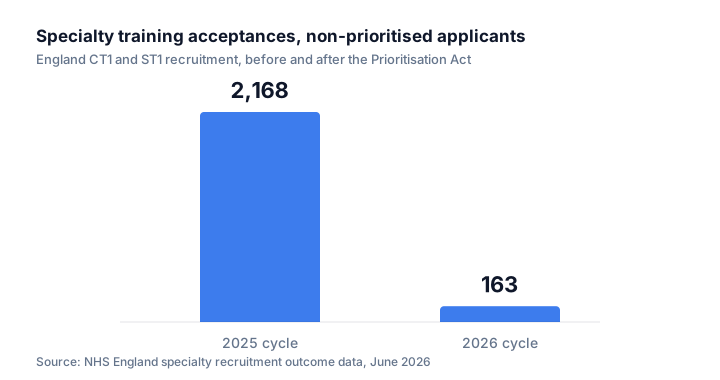
The Medical Training (Prioritisation) Act 2026 is law. It received Royal Assent on 5 March 2026, took effect on 6 March, and requires priority for defined groups when UK Foundation and specialty training places are allocated. The immediate result was stark: non-prioritised acceptances for CT1 and ST1 posts fell from 2,168 in 2025 to 163 in 2026.
PLAB still leads to GMC registration, but registration and training recruitment are separate. Anyone budgeting for the route now has to allow for the possibility of service work before specialty training, or decide whether GMC registration has value for another reason.
What the Act says
The Medical Training (Prioritisation) Act 2026 separates Foundation allocation from specialty recruitment, then defines who receives priority in each.
For the Foundation Programme, priority covers graduates with a UK primary medical qualification. It also covers graduates of medical schools in Ireland, Iceland, Liechtenstein, Norway and Switzerland. Other international graduates are not banned from applying, but places must be allocated to prioritised applicants first. Specialty training has a wider priority group. It includes UK and Irish medical graduates, graduates from the same four named European countries, and doctors who have completed or are completing the relevant qualifying UK programme. A Foundation Programme completer applying for core training is therefore prioritised. A doctor who completed the one-year standalone FY2 route also counts. For higher specialty training, the qualifying route depends on the programme, and every applicant must still satisfy its person specification.
For offers made in the 2026 cycle, the Act also used a defined set of immigration statuses. These included British and Irish citizens, Commonwealth citizens with right of abode, people with indefinite leave to enter or remain, and people granted leave under specified European residence-scheme rules. That was a 2026 mechanism. NHS England states that the immigration-status category does not carry over automatically for posts starting in 2027.
Timing matters. For posts starting in 2026, prioritisation was introduced during an active recruitment cycle, so it operated at the offer stage. For posts starting from 2027, it applies from shortlisting through to offers. That change can reduce the number of non-prioritised applicants who reach interviews, rather than changing only the order in which appointable candidates receive offers.
The NHS England applicant guidance also confirms that ministers can specify additional priority groups by regulation. Those future groups are not settled. The Act allows government to add categories such as immigration status by regulation, not yet defined. No candidate should build a 2027 plan around a category that has not been made.
The Act applies to Foundation and specialty training. It does not cover locally employed doctor posts, trust-grade jobs, SAS roles or consultant appointments. That distinction is the reason a service-job-first plan remains possible even though direct entry to training has become much harder.
The 2026 numbers
The first published results remove any doubt about the scale of the change. NHS England recorded 33,953 appointable CT1 and ST1 applications competing for 9,315 posts in 2026, roughly four appointable applications per post. Priority candidates filled 98% of posts, compared with 72% in 2025.
Applications are not individual doctors. A candidate could make as many as five specialty applications, and one person could be appointable in more than one. The 33,953 to 9,315 comparison measures pressure on posts, not the probability that a unique applicant obtained a job. Even with that limitation, the change in accepted offers provides a clean year-to-year signal because each successful doctor can accept only one final training offer.
The effect on non-prioritised candidates was larger than the percentage alone suggests. According to NHS England's recruitment publication, first published on 21 June 2026, their accepted offers fell from 2,168 to 163 in one annual cycle. Those 163 acceptances were concentrated in specialties or locations that priority candidates had not taken.
General practice shows the direction most clearly. In 2026, 100% of accepted GP training places went to UK graduates or applicants already working in the NHS, up from 62% in 2025. A newly registered IMG outside the priority group cannot assume GP training will be the next step.
The pressure pre-dates the Act. In the 2025 England cycle, 91,999 applications competed for 12,833 posts, about seven applications per post. The equivalent ratio was 4.7 to 1 in 2024 and 1.9 to 1 in 2019. Prioritisation changed who advances, but it arrived after competition had already risen sharply.
What the exam volumes say
PLAB demand has started to respond. The GMC's pass-rate table shows that PLAB 2 sittings fell from 19,594 in 2024 to 14,689 in 2025. That is a 25% reduction. Of the 2025 candidates, 8,787 passed, producing a 59.8% pass rate.
Fewer sittings do not mean that NHS employment has caught up with registration. The GMC states the boundary plainly in its PLAB 2 booking guidance: "The number of PLAB places is not directly linked to the number of job vacancies". Exam availability is not workforce planning.
The 2025 table also shows the difference between exam risk and career risk.
Of 14,689 PLAB 2 sittings, 5,902 ended without a pass. The 8,787 successful candidates cleared the clinical assessment, but each then entered a separate registration and employment process. A realistic budget therefore needs to survive both possibilities: another exam attempt after a fail, or a delayed first job after a pass.
PLAB still tests whether an overseas-qualified doctor can meet the standard for UK registration.
It does not allocate a first NHS job, create a trust-grade vacancy or confer priority for specialty selection. Passing remains valuable, but its value depends on what follows. Treating the pass itself as an employment outcome is the central planning error in 2026.
Deciding whether PLAB still fits
The Act does not govern locally employed doctor, trust grade or SHO posts. Doctors willing to compete for service work can still gain paid NHS experience, references and evidence of UK practice before applying for training later. The first NHS job guide covers those job titles, sponsorship and the evidence employers request. The first job is a separate competition, and PLAB does not guarantee one.
GMC registration can also contribute to later applications in Australia or New Zealand after the required UK experience. Both countries add their own registration, supervision, recency and job conditions. The Australia and New Zealand registration guide sets out those requirements.
Priority status must be checked against the rules for the relevant recruitment year. A UK spouse does not by itself establish priority. NHS England also states that the 2026 immigration-status category does not carry over automatically to posts starting in 2027.
The 2026 GP result is especially important for anyone relying on immediate training income: all accepted GP places went to UK graduates or doctors already working in the NHS. The 163 non-prioritised acceptances across CT1 and ST1 also show why an assumed place in GP, IMT or another programme cannot support a budget on its own.
Career stage and finances change the calculation. An experienced doctor may value an NHS service post without CT1 entry. A recent graduate may need to preserve money for another national route. The relevant question is what GMC registration would be used for if specialty training did not follow soon after arrival.
Why Foundation completion changes the calculation
Completion of the UK Foundation Programme is the clearest statutory bridge from IMG status to specialty-training priority. NHS England confirms that both the two-year Foundation Programme and one-year standalone FY2 count when a doctor applies for relevant core training. This makes FY2 standalone strategically important, but it does not make entry easy. Foundation recruitment is itself prioritised, and standalone FY2 places are limited.
The employment market surrounding that route is also weak. A BMA survey conducted from 21 to 28 July 2025 included 4,401 resident doctors; 34% reported having no substantive job or regular locum work arranged for August. That survey covered resident doctors generally and did not publish an IMG breakdown, so it describes the wider bottleneck rather than an IMG-specific unemployment rate.
GMC data points in the same direction, with an important limitation. The GMC's 2025 workforce reporting found that only 13% of the 2024 IMG PLAB joiner cohort had connected to a designated body within six months of first registration, down from 20% for the 2023 cohort. A designated-body connection is a strong employment indicator, but absence of one is not identical to confirmed unemployment. Some doctors may not yet have moved to the UK or may not be practising there. The same reporting recorded 4,880 international medical graduates relinquishing their UK licence in 2024, 26% more than in 2023. Raw departures rose alongside the total non-UK-qualified workforce, so the figure should be treated as an under-employment and retention warning, not proof that 4,880 doctors left solely because they could not find work.
Foundation completion is therefore a real strategic route, not a shortcut. It can create priority for the next recruitment stage. Getting the Foundation place, securing employment and remaining financially stable until that point are separate problems.
Questions to settle before paying
The budget should extend beyond exams, registration, visa costs, travel and accommodation to cover a job search of uncertain length. There is no reliable public average for the wait to a first NHS service job. Applications can include locally employed doctor, clinical fellow, trust grade and SHO-level posts, with each form matched to its person specification.
Specialty choices need arithmetic. GP and Core Psychiatry use the MSRA as the sole ranking tool for the referenced 2026 recruitment routes, while Core Surgical Training uses it as a shortlisting gate and 10% of final ranking after shortlisting. Other specialties combine it with later selection stages. The MSRA after PLAB guide explains those weightings, because a strong MSRA score cannot overcome non-priority status in the same way across every programme.
Doctors considering Australia or New Zealand should identify the regulator, experience requirement and supervision route before relying on a later move. They should also check whether service work in the UK would be worthwhile if a training place did not follow within the expected timetable. If the answer depends entirely on a quick specialty offer, the 2026 data supports delaying payment until the plan changes.
Questions candidates actually ask
Is PLAB still worth it in 2026?
It may still suit doctors who would value a service job, NHS experience or a later international route even without quick entry to UK specialty training. A plan that depends on entering GP, IMT or another UK specialty programme within a year of arrival does not match the 2026 offer data.
Does the Prioritisation Act ban IMGs from UK training?
No. Non-prioritised candidates may still apply, but prioritisation operated at the offer stage in 2026 and extends from shortlisting through offers for 2027 starts. The practical effect is severe: non-prioritised acceptances fell from 2,168 to 163 in the 2026 cycle.
Do IMGs who complete UK Foundation count as priority?
Yes. Completion of the UK Foundation Programme, including one-year standalone FY2, gives priority for relevant core or specialty training under the 2026 rules. Applicants must still meet the programme's eligibility criteria and compete successfully.