
PLAB 2 has 16 scenarios, each lasting eight minutes, and covers work expected of a doctor appointed to an F2 role. Stations draw on consultations, examinations, practical procedures, telephone stations and interpersonal tasks, and every station is assessed across the same three domains. Prepare across these station types and clinical systems because coverage is more dependable than predicting a future circuit.
The station types the GMC lists
The GMC guide to how you will be tested names the practical and interpersonal skills that may be assessed and sets the examination expectations.
Practical and examination skills
- Examinations of the abdomen, breast, chest, hand, heart and joints; rectal or bimanual vaginal examination; ear, eye and nervous system examination with equipment; mental state examination; possible use of a high-fidelity simulator.
- Checking blood pressure; venepuncture; peripheral cannula; drug dosage calculation; IV injections.
- Mixing and injecting drugs into an IV bag; IM and SC injections; basic CPR for adults and children; suturing.
- Interpreting ECGs, X-rays or other investigation results; interpreting basic respiratory function tests; urinary catheterisation; cervical smear; safe disposal of sharps.
Interpersonal skills
- Telephone consultation stations.
- Explaining diagnosis, investigation and treatment; involving the patient in decision-making; communicating with relatives; communicating with health care professionals.
- Breaking bad news; giving clear legible written instructions, such as prescribing; obtaining informed consent for an invasive procedure or consent for a post-mortem; dealing with anxious patients or relatives.
- Giving discharge instructions; advising on lifestyle, health promotion or risk factors.
What changes from one station to another
A PLAB 2 station is a clinical encounter with a defined task. A diagnosis alone does not tell you what to do during the eight minutes. The setting, the person you meet and the information given in the instructions all change what the station asks of you.
The setting defines what is possible. A GP consultation, acute ward, telephone call and community review create different priorities, even when the underlying complaint is headache. A patient, parent, relative, colleague or actor using a manikin may also hold different information and expect a different form of explanation.
The task may ask you to assess and manage, examine, perform a procedure, counsel, explain a result or address a professional concern.
The patient script controls what emerges and when. A role player may disclose a red flag only after a focused question, resist a proposed treatment, or reveal a concern at minute 6.
Silence, anger, embarrassment or repeated requests for reassurance can be part of the clinical problem. If you recite the same history in every case, you can miss both the cue and the task.
Those elements feed directly into the three PLAB 2 scoring domains. Data gathering, technical and assessment skills reward relevant questions, examination technique and interpretation. Clinical management rewards a safe plan that follows from the assessment. Interpersonal skills reward listening, clear language, professionalism and patient involvement.
All 3 domains can be tested in the same eight minutes. A correct diagnosis cannot make up for a rushed examination or a plan delivered without checking the patient's concern.
What this practice bank contains
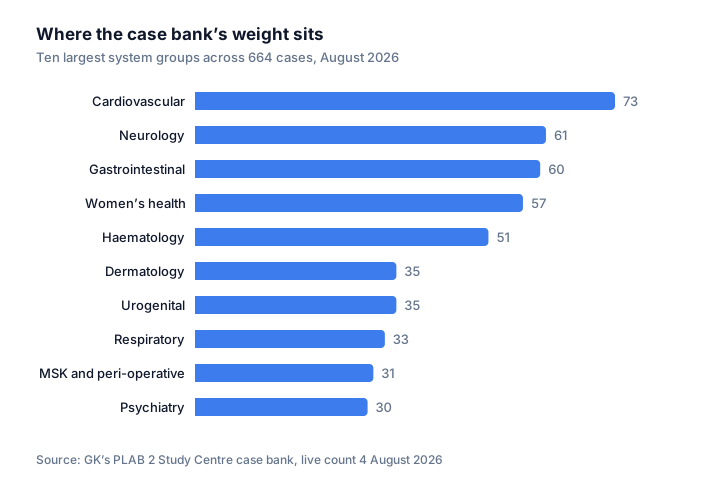
The GMC does not publish a future PLAB 2 stations list by system.
The following figures describe the 664 cases in GK's PLAB 2 Study Centre's bank as of August 2026, based on the platform's live case aggregate. They show this bank's coverage. They do not predict the frequency of systems in any GMC diet.
| System or cluster | Cases |
|---|---|
| Cardiovascular | 73 |
| Neurology | 61 |
| Gastrointestinal | 60 |
| Women's Health | 57 |
| Haematology | 51 |
| Dermatology | 35 |
| Urogenital | 35 |
| Respiratory | 33 |
| Musculo/Rheum/Peri-op | 31 |
| Psychiatry | 30 |
| Headaches | 28 |
| Urogenital/Nephrology | 27 |
| Miscellaneous | 26 |
| Musculoskeletal | 24 |
| Endocrinology | 23 |
| ENT | 22 |
| Paediatrics | 15 |
| Ophthalmology | 9 |
| Counselling | 5 |
| Medical Errors | 5 |
| Abuse & Safeguarding | 4 |
| Other small clusters combined | 10 |
The 10 cases in the final row span small clusters including breaking bad news and end of life, colleague-related problems, gender identity and inclusive care, angry patients, and pre-operative or post-operative work.
Exact counts were not published separately for those small clusters in the August 2026 aggregate. A more detailed numerical split would imply precision the source does not provide.
The largest 5 systems contain 302 of 664 cases, about 45%. That proportion describes the bank, not how practice time should be divided.
Low-count communication and professional categories create a particular trap. Medical Errors has 5 cases and Abuse & Safeguarding has 4, while angry patients and breaking bad news sit within smaller clusters.
The smaller categories still expose skills that system-based revision may miss, including disclosure, boundaries, escalation and difficult conversations.
Case types versus clinical systems
A system tells you which medicine is involved. A case type tells you what you must do in the eight minutes.
Both dimensions need coverage. The examples below are illustrative typical setups created for preparation. They are not reproductions of, or claims about, content from any past or future GMC exam.
History and management consultations
Here you need selective questions, a working assessment and enough time left to give a safe plan.
You might see a 52-year-old in general practice with episodic palpitations, a parent calling about a child with cough and reduced drinking, or a ward patient with new unilateral calf swelling. You must find the information that changes risk, explain the likely problem without claiming more certainty than you have, and give escalation or safety-netting that fits the scenario.
A memorised system review is especially costly here. If unfocused questions take 5 minutes, management becomes a hurried list. Practise identifying the dangerous alternative, choosing the immediate action, then explaining the next 24 hours or the exact trigger for urgent help.
Examinations and procedures
These cases make technique visible within the same eight-minute limit.
Illustrative setups include demonstrating a focused abdominal examination on a manikin, explaining and performing the safe opening steps of venepuncture, or assessing a simulated patient with a painful knee. They reward preparation, consent, correct sequence, infection control where relevant, patient dignity and an interpretation connected to the task.
Narration should support the performance rather than replace it. A candidate who names 12 steps but omits consent or performs them out of order has not shown safe technique. Practice should therefore use equipment when possible and record where the sequence breaks under an eight-minute limit.
Counselling and communication-heavy stations
These stations still require clinical accuracy within all 3 scoring domains.
The central difficulty is helping another person understand and decide. Illustrative setups include discussing the start of long-term anticoagulation, explaining an abnormal screening result, or responding to an angry relative after a delayed appointment. The reward comes from discovering the person's concern, giving information in manageable parts, checking understanding and agreeing a next step.
Stock empathy phrases fail when the concern changes. A patient worried about bleeding needs a different conversation from one worried about work, pregnancy or daily monitoring. In an angry-patient setup, acknowledging the effect of a 2-hour delay does not mean accepting an inaccurate accusation. The station needs calm boundaries and a workable next step.
Ethical and professional scenarios
These cases test whether safe professional judgement survives eight minutes of pressure.
Illustrative setups include a colleague disclosing a medication error, an adolescent asking about confidentiality, or a consultation that raises concern about abuse of an adult at risk. The candidate may need to clarify immediate danger, preserve confidentiality within its limits, document, escalate and explain why information must be shared.
The sequence matters. Automatically promising secrecy can make later safeguarding unsafe, while immediate confrontation can shut down a disclosure. Practise more than one version of these conversations, including situations involving colleagues and distressed relatives, because one polished ethics script cannot cover every duty.
Why remembered stations are not a syllabus
A circulating list of stations remembered from an earlier diet can create false confidence across 16 scored scenarios.
A remembered label such as "postnatal headache" does not preserve the instructions, the role player's undisclosed concern, the clinical observations or the examiner's task. Rehearsing one reported version can train you to ignore a different but clinically important cue.
PLAB became aligned with the MLA requirements in August 2024, as the guide to UKMLA and PLAB 2 explains, while the official standard still allows anything appropriate to an F2 role. Borderline regression sets station cut scores for each diet; it does not reward possession of a particular list of remembered stations. Preparation still needs breadth, safe reasoning and attention to all 3 domains.
There is also a firm professional boundary. The GMC classifies sharing actual exam content in private conversations, on social media or through online forums as misconduct. Legitimate case writing uses illustrative setups built from the published standard. It does not reproduce protected exam material.
A mapped bank makes omissions visible. It can show 20 attempted cardiovascular cases but no safeguarding case, or 10 histories but no procedure. Shared folders of remembered stations usually grow around whatever people discussed most recently, not around what you still need.
Using the bank to find gaps
Coverage should come before completion in a 664-case bank.
Do not let a category remain at zero. A first pass should include respiratory, psychiatry, dermatology, endocrine, paediatrics, ENT, ophthalmology, counselling and the small professional clusters as well as the larger systems.
The next pass should cross clinical systems with different kinds of station task.
A mixed session might include a history and management consultation, an examination or procedure, a communication-heavy case and an ethical or professional scenario. Each attempt lasts eight minutes. Spoken practice matters because silent reading cannot reveal a 4-minute explanation, missed emotional cue or closing plan that collapses when interrupted.
After every attempt, the review needs 3 entries, one under each scoring domain. The data-gathering entry records one missed or irrelevant point. The management entry records one unsafe, vague or delayed decision. The interpersonal entry records one behaviour that affected clarity, dignity or involvement. After 12 attempts, repeated entries should determine the next set of cases. The six-week preparation plan gives that cycle a calendar, while a full mock tests whether the repairs survive a 16-station circuit.
GK's PLAB 2 Study Centre's premium access includes the full 664-case bank as of August 2026, with checklists and scripts. Reading all 664 in sequence is unlikely to fix your weak areas. Use the filters to find neglected systems and station types, practise them aloud under time, then check whether the same errors return in a mixed circuit.
Questions candidates actually ask
How many cases should you prepare for PLAB 2?
There is no official number of cases to memorise because the GMC can test anything an F2 doctor might meet. Preparation should cover the main clinical systems and every major station type, then use cases to practise safe reasoning rather than fixed scripts. A mapped bank of hundreds makes coverage easier to measure.
Is a list of remembered stations enough to pass PLAB 2?
No. A remembered station cannot establish the exact task, role-player behaviour or scoring detail, and such lists leave predictable gaps outside recently discussed topics. Sharing actual exam content also breaches GMC misconduct rules, so preparation should use legitimate illustrative cases mapped across the syllabus.
Which systems come up most in PLAB 2?
The GMC does not publish a system-by-system station forecast. Across the 664 cases in GK's PLAB 2 Study Centre's bank as of August 2026, the five largest categories are Cardiovascular, Neurology, Gastrointestinal, Women's Health and Haematology. Together they account for 302 cases, about 45% of that bank.